
Selection & sizing 6 min read
Pillow Block Bearings: How to Read the Part Number and Pick the Right One
Pillow block bearings explained: decode a UCP205 part number, pick set screw or eccentric collar locking, and avoid the inch-shaft trap.
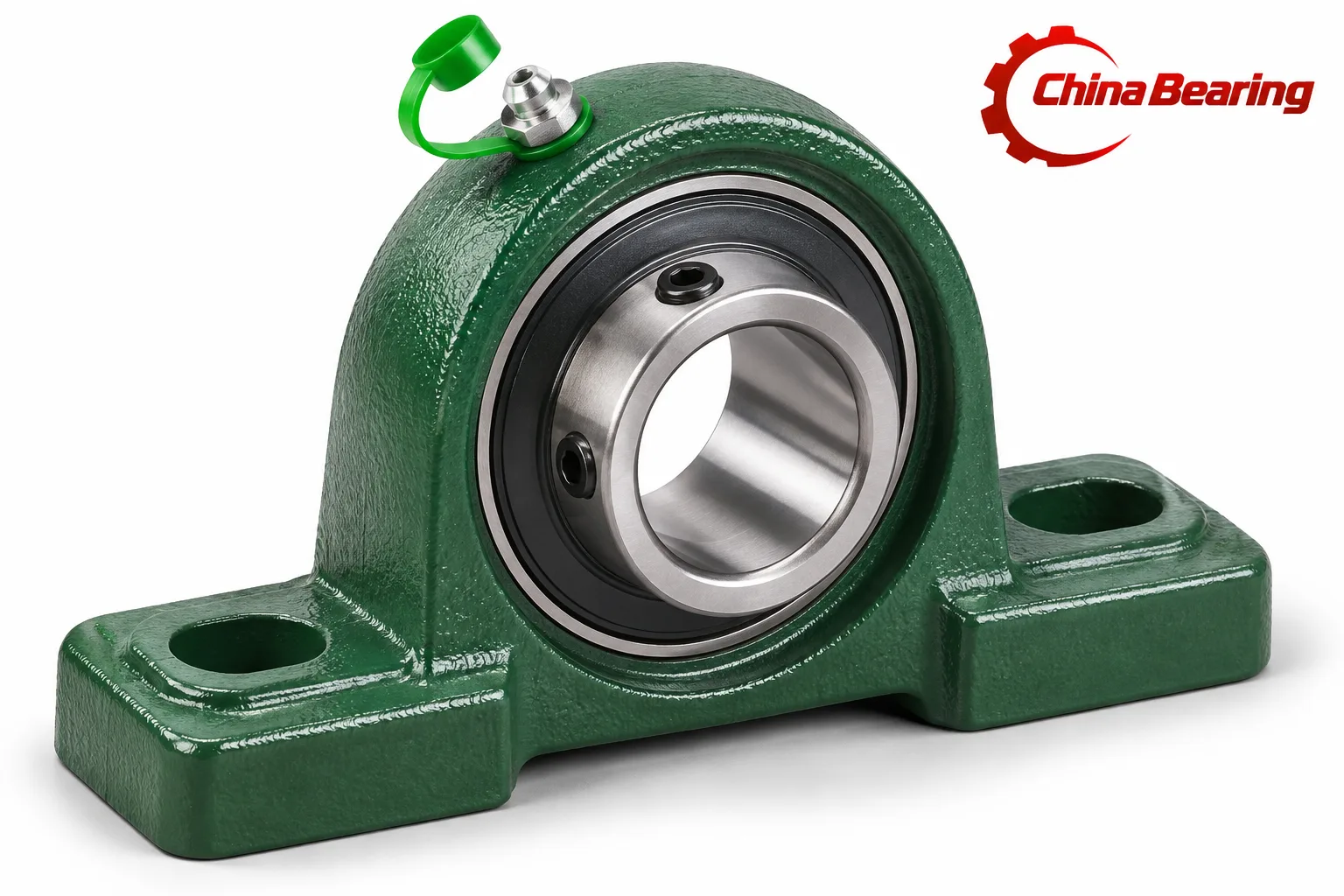
A UCP205 pillow block holds a 25 mm shaft 36.5 mm above its base, on two bolt holes 105 mm apart, according to Timken’s catalog. In fact, every one of those numbers is coded into the part number, and once you can read it, choosing pillow block bearings gets much easier.
A pillow block bearing is a bearing in a housing that bolts to a flat surface parallel to the shaft. Most pillow block bearings use a replaceable insert bearing with a spherical outside, so the unit can absorb a little misalignment. This guide shows how to decode the part number, which locking method to choose, and the one sizing mistake that catches inch-shaft buyers.
What pillow block bearings are made of#
There are two parts: the housing and the insert. Our mounted bearings range covers both. The housing is usually cast iron, with bolt holes or slots in the feet so you can adjust it on the frame. The insert, on the other hand, is a wide inner ring ball bearing that locks onto the shaft.
GlobalSpec notes that these inserts are usually self-aligning, and NTN explains why: the spherical fit between the insert’s outer ring and the housing bore lets the bearing compensate for misalignment. That’s also the main reason people choose a housed unit over a bare bearing in a machined bore.
Pillow block bearings are one family of mounted bearings. However, if your frame face is perpendicular to the shaft, a flange unit is the better fit. See our flanged ball bearing units for that layout.
How to read the part number on pillow block bearings#
Most ball bearing units follow the same naming pattern. Take UCP205:
| Part | Meaning |
|---|---|
| UC | Insert with set screw locking |
| P | Pillow block housing (P205) |
| 2 | Light series (200 series) |
| 05 | Bore code: 05 × 5 = 25 mm shaft |
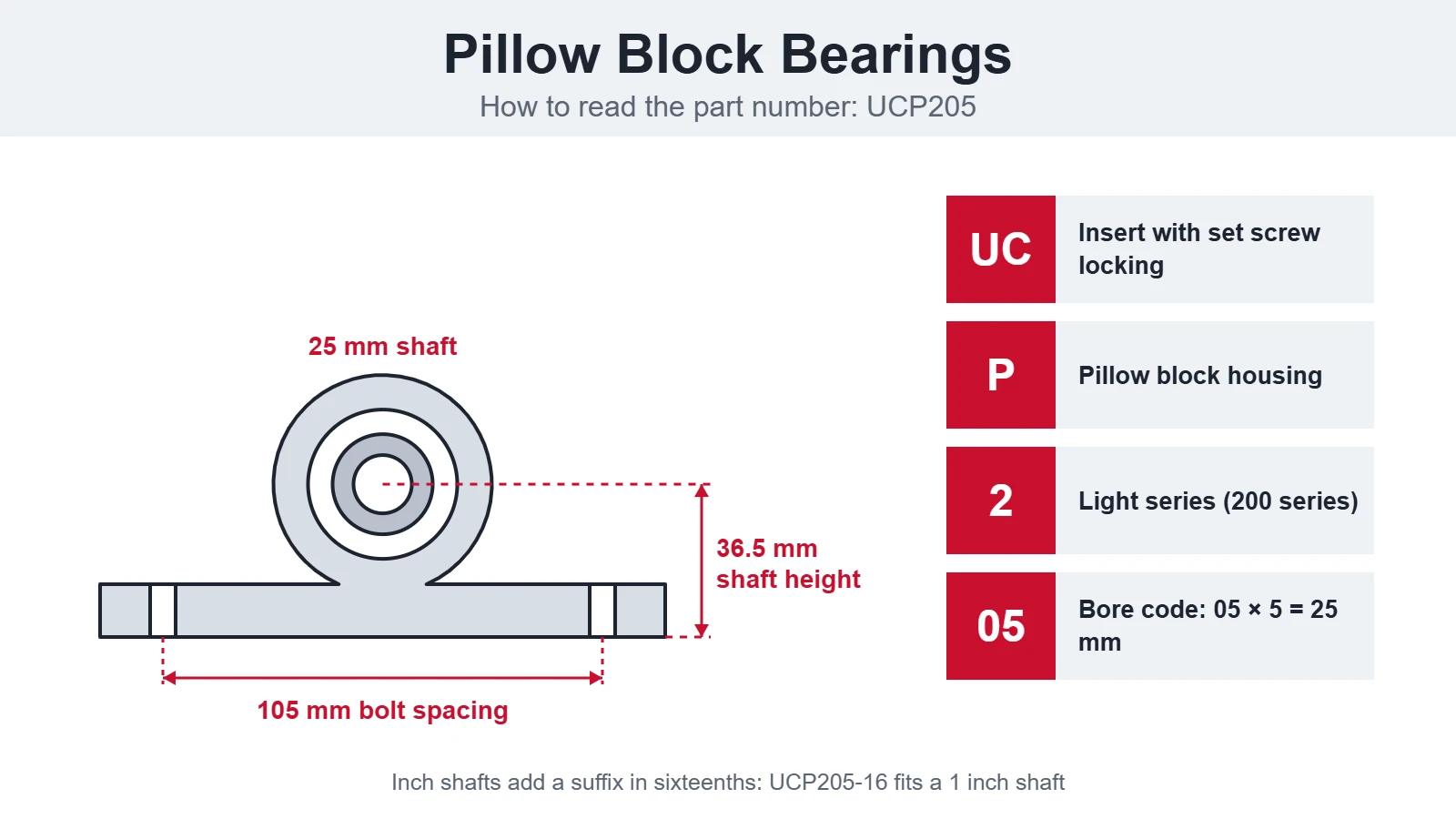
The bore code works the same way as on ordinary ball bearings. From 04 upward, multiply by five, so 204 is 20 mm, 205 is 25 mm, 206 is 30 mm.
Inch shafts add a suffix in sixteenths of an inch. For example, a UC205-16 fits a 1 inch shaft (16/16), and a UC207-20 fits a 1-1/4 inch shaft (20/16). Bearing Boys’ UC200 table shows the 205 size in both forms: UC205 for 25 mm and UC205-16 for 1 inch.
The trap: the same shaft, two different units#
Here’s where inch buyers get caught. A 1-1/4 inch shaft fits both a UCP206-20 and a UCP207-20. Same suffix, same shaft, different units.
PRP’s dimension table shows how far apart they are:
| Dimension | UCP206-20 | UCP207-20 |
|---|---|---|
| Shaft | 1-1/4 in | 1-1/4 in |
| Base to shaft center | 1-11/16 in | 1-7/8 in |
| Overall length | 6-1/2 in | 6-9/16 in |
| Bolt hole spacing | 4-3/4 in | 5 in |
| Insert inner ring width | 1.500 in | 1.689 in |
| Housing | P206 | P207 |
Swap one for the other on an existing frame and the shaft sits 3/16 inch higher or lower, and the bolt holes miss by a quarter inch. Because there is a unit at each end of the shaft, that’s enough to throw the shaft out of line.
So when you replace a unit, copy the full number from the old housing, including the series digit. The insert carries the same number, so check both if the housing casting is worn. In other words, “a 1-1/4 inch pillow block” isn’t enough information to order with.
Set screw, eccentric collar or adapter sleeve?#
The letters before the P tell you how the insert grips the shaft. NTN-SNR lists four methods: set screws, an eccentric locking collar, an adapter sleeve, or a press fit.
| Locking method | Common prefix | Good for | Watch out for |
|---|---|---|---|
| Set screw | UC | Most general machinery | Screw tips bite into the shaft surface |
| Eccentric collar | UEL, SA | Locks via an eccentric step on the inner ring | Follow the maker’s tightening direction |
| Adapter sleeve | UK + H sleeve | Larger shafts, easier removal | Needs a tapered bore insert |
Set screws are the most common, so installing them properly matters. In its tech tip for stainless inserts, NTN’s tightening procedure for two-screw inner rings is to torque the first screw to half the recommended value, the second to full, then bring the first up to full. Above all, use the torque value the maker lists for your insert size.
In addition, our guide to mounting a bearing without damaging it covers the rest of the install, from shaft cleaning to final checks.
How much load can one unit carry?#
The housing rarely limits capacity. Instead, the insert does. For example, NTN rates the UC205 insert inside a UCP205 at 14.0 kN dynamic and 7.85 kN static, with a maximum speed of 5,900 RPM on grease.
To see what that means in hours, use the basic life formula for ball bearings, L10 = (C/P)³. For instance, with a steady 2 kN radial load at 300 RPM:
(14.0 / 2)³ = 343 million revolutions.
Then 343,000,000 ÷ (300 × 60) = about 19,000 hours.
However, double the load to 4 kN and the life drops to about one eighth. That cube relationship is why a slightly bigger unit often pays for itself. Our L10 life guide explains what the number does and doesn’t promise.
Alignment and grease: keeping pillow block bearings running#
The unit forgives some misalignment, but not much. NTN’s install guidance for its stainless insert units calls for less than 2 degrees of shaft misalignment. Pillow block bearings adjust for small mounting errors. However, they won’t fix a bent frame.
Most cast iron units also have a grease fitting. NTN lists the UCP205 as relubricatable with an operating range of -40 to 120 °C. How often you regrease depends on speed and contamination, and our article on grease or oil by speed factor helps you choose the lubricant.
Dirty environments need more than the insert’s own seals. For this reason, end covers close off the open side of the housing. We stock bearing end covers in sizes from 204 to 226, such as the ECY 205 push-in end cover for 205-size units; check the cover number against your housing before ordering.
When the unit fails#
Noise and heat at the housing are the usual warnings. Find the cause first, or the new unit will go the same way.
Our guide to reading a failed bearing shows what the raceways and seals can tell you.
Also, the insert can usually be replaced on its own. NTN’s insert replacement tip explains how to line up the outer ring with the housing’s loading slots, then remove it.
Quick answers#
What is the difference between a pillow block and a plummer block?#
People often use the terms for the same thing. Wikipedia notes that “pillow block” usually refers to a light duty housing, often one piece, and RS describes pillow blocks as suited to lower loads than plummer blocks.
What does UCP205-16 mean?#
A set screw insert (UC) in a P-type housing, 200 series, size 05, fitted for a 1 inch shaft (16/16 inch).
Can I replace only the insert?#
Yes, in most cases. Match the insert number exactly, including any inch suffix, then line the outer ring up with the housing slots to fit it.
Where can I buy pillow block bearings in bulk?#
Send the full unit numbers and quantities through our contact page, and we’ll quote matching pillow block bearings or equivalents.
Keep reading
The next questions engineers usually ask
-
1 Inch Pillow Block Bearing: Which Unit Fits, and at What Shaft Height
A 1 inch pillow block bearing comes in several sizes that hold the shaft at different heights. Compare UCP205-16, UCPK205-16, UCSP205-16 and…
-
Flange Mount Bearings: How to Pick the Right Housing for Your Shaft
Flange mount bearings compared: 4-bolt UCF, 2-bolt UCFL, 3-bolt, adjustable and piloted UCFC housings, with real 205-size dimensions and mounting tips.
-
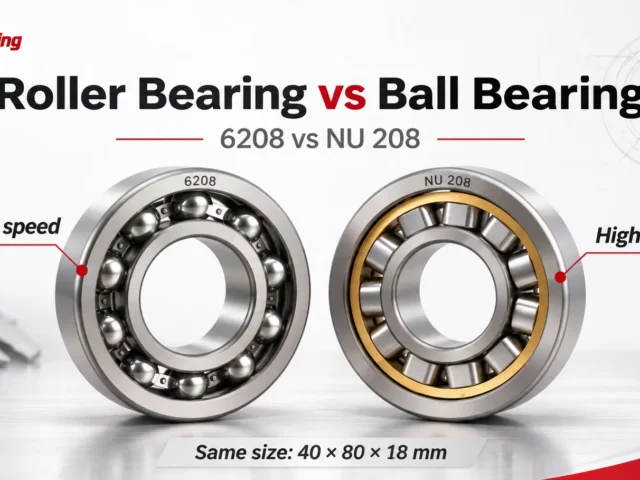
Roller Bearing vs Ball Bearing: How to Choose, With a Same-Size Example
A 6208 ball bearing and an NU 208 roller bearing share one 40 x 80 x 18 mm envelope, yet the roller…
Working with us
From a bearing number to the right part, with one engineering contact.
Send a part number, a drawing or the markings from the old bearing. We confirm the equivalent, the options and the lead time.
- Cross-reference helpOld markings or another brand's number, matched to an equivalent.
- Selection supportLoad, speed and fit checked against your duty before you order.
- Configurable optionsAsk about clearance, seals, cages and lubrication for your application.
- Clear quotesPrice, quantity breaks and lead time set out in one reply.
2 questions