Selection & sizing 6 min read
Roller Bearing vs Ball Bearing: How to Choose, With a Same-Size Example
A 6208 ball bearing and an NU 208 roller bearing share one 40 x 80 x 18 mm envelope, yet the roller version lasts about 16 times longer at 5 kN. Here is when each type is the right choice.
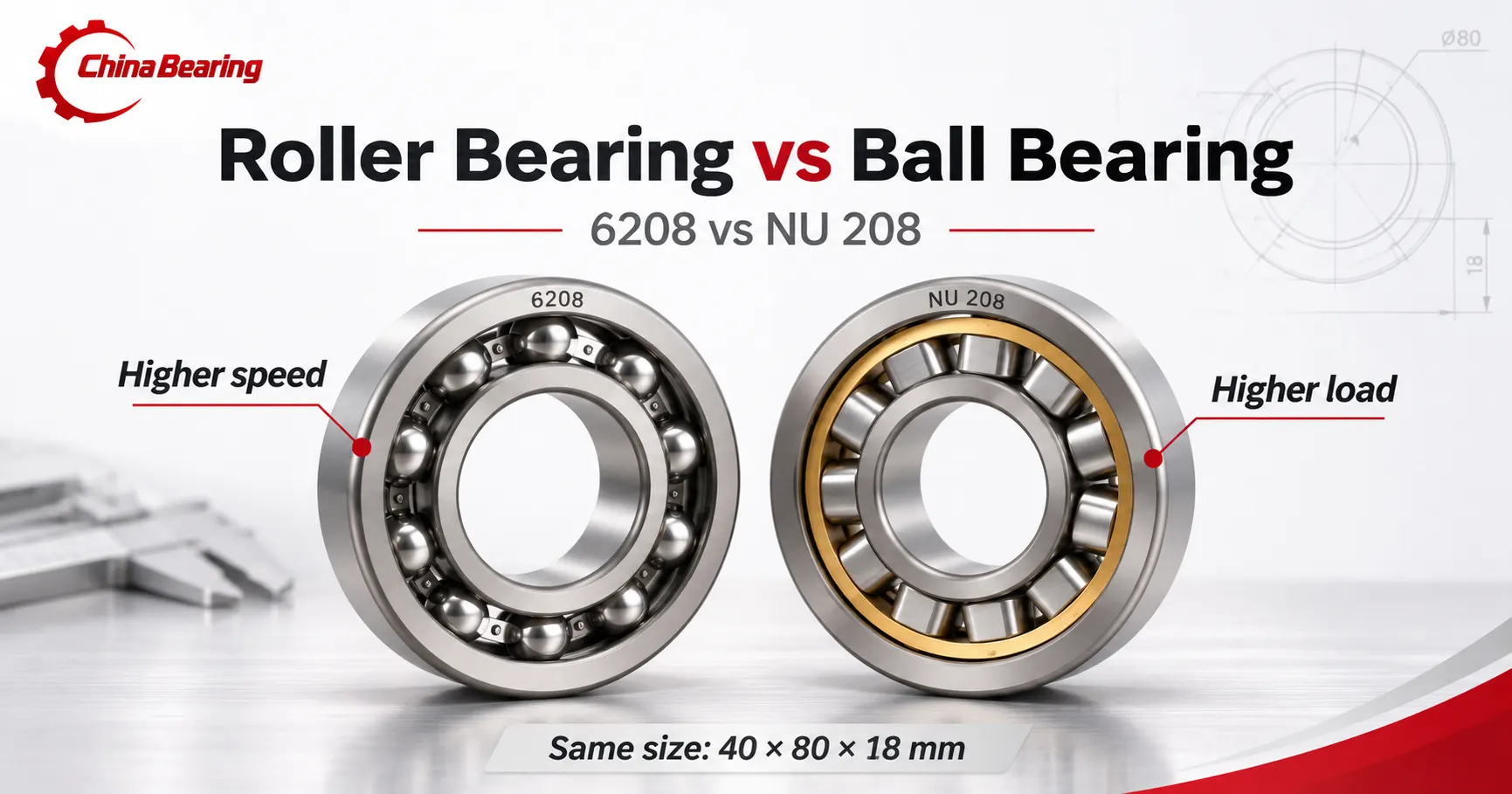
A 6208 deep groove ball bearing and an NU 208 cylindrical roller bearing are exactly the same size: 40 mm bore, 80 mm outside diameter, 18 mm wide. However, SKF rates the roller version at 62 kN of dynamic load and the ball version at 32.5 kN. That gap is the whole roller bearing vs ball bearing question in two numbers.
In general, choose a ball bearing when speed, quiet running, light loads or axial load in both directions matter most. Instead, choose a roller bearing when the radial load is heavy, there’s shock, or you need a longer life in the same space. The rest of this guide then shows how big the difference really is, where each type fails, and how to decide for a real shaft.
Roller bearing vs ball bearing at a glance#
Above all, the difference starts with contact. A ball touches the raceway at a point, while a roller touches it along a line. As a result, a roller bearing can carry more radial load in the same space.
| Factor | Ball bearing | Roller bearing |
|---|---|---|
| Contact with raceway | Point | Line |
| Radial load capacity, same size | Lower | Higher (about 2x in our example) |
| Speed | Higher | Lower |
| Axial load | Both directions (deep groove type) | Depends on roller type; cylindrical NU types take almost none |
| Shock loads | Less suitable | Better |
| Misalignment | Tolerates more (except vs spherical rollers) | Cylindrical types tolerate very little |
| Noise | Quieter | Louder under load |
| Typical cost | Lower | Higher |
Sources for the table: MISUMI and Thomasnet comparisons, plus the catalog data below.
Same size, same load: 6208 vs NU 208 worked example#
Spec tables tell you one bearing is “stronger.” However, they rarely show what that means in hours. So we ran the standard life calculation on two bearings that fit the same housing.
The catalog numbers#
| Data (SKF catalog) | 6208 deep groove ball | NU 208 ECP cylindrical roller |
|---|---|---|
| Size (d x D x B) | 40 x 80 x 18 mm | 40 x 80 x 18 mm |
| Basic dynamic load rating C | 32.5 kN | 62 kN |
| Basic static load rating C0 | 19 kN | 53 kN |
| Reference speed | 18,000 r/min | 9,500 r/min |
| Fatigue load limit Pu | 0.8 kN (6208-2Z) | 6.7 kN |
The calculation#
Basic rating life uses the ISO formula L10 = (C/P)^p, in millions of revolutions. SKF’s bearing selection notes give the exponent p as 3 for ball bearings and 10/3 for roller bearings. Because of that small change in the exponent, roller bearings pull further ahead as loads rise.
First, we assumed a pure radial load of 5 kN on a shaft turning at 1,500 r/min, then converted revolutions to hours:
- Ball bearing: (32.5 / 5)³ = 274.6 million revolutions, or about 3,050 hours.
- Roller bearing: (62 / 5)^(10/3) = 4,413 million revolutions, or about 49,000 hours.
In other words, that’s roughly 16 times the rated life from a part that fits the same hole. At a lighter 2 kN load the gap grows to about 22 times. At 10 kN, on the other hand, the ball bearing drops to about 380 hours. On a machine running two 8 hour shifts, that means a new bearing about every three and a half weeks.
What the calculation doesn’t tell you#
L10 is the life that 90% of a group of identical bearings should reach. It also assumes good lubrication and a clean, correctly mounted bearing. Our plain arithmetic guide to L10 explains what the number does and doesn’t promise.
Catalog values also vary by brand. For example, Schaeffler lists its 6208 at 31 kN, against SKF’s 32.5 kN. Therefore, always compare ratings from the same catalog, or from the supplier you’ll actually buy from.
Finally, the NU 208 has a catch: like most cylindrical roller bearings, it carries little or no axial load. If your shaft sees any thrust, this “16 times better” bearing is the wrong part.
When a ball bearing is the better choice#
The 6208’s reference speed is almost double the NU 208’s. Point contact produces less friction and heat, which is why ball bearings suit fast, lightly loaded machines. For example, RS lists centrifugal pumps and industrial fans among the uses for a sealed 6208.
Ball bearings also win on:
- Axial load in both directions. A deep groove ball bearing takes radial load plus some thrust either way. As a result, it simplifies a two-bearing shaft.
- Misalignment. Thomasnet’s guidance puts a ball bearing’s comfortable angular misalignment at around 0.002 to 0.004 rad, against about 0.001 rad for a cylindrical roller bearing.
- Price. At RS UK, for orders of 25 or more, an SKF 6208/C3 lists at £12.86 and an NU 208 ECP at £55.04. Of course, prices vary by market and brand, but the gap is large.
In short, if the load is light and the speed high, the roller bearing’s extra capacity is money spent on nothing. Deep groove ball bearings such as our 6205-2RS sealed ball bearing cover most of these positions. To choose between 2RS and ZZ, see our sealed or shielded guide.
When a roller bearing is the better choice#
In the roller bearing vs ball bearing decision, heavy radial load and shock push you toward rollers. Indeed, Thomasnet notes that roller bearings handle shock and impact better, which matters in heavy, impact-loaded machinery. The type of roller then decides what else the bearing can do:
| Roller type | Handles | Watch out for |
|---|---|---|
| Cylindrical (N, NU, NJ) | High radial load at moderate speed | Little or no axial load, low misalignment tolerance |
| Tapered | Combined radial and one-direction axial load | Usually mounted in opposed pairs |
| Spherical | Heavy combined load, self-aligning | Lower speed than a ball bearing |
| Needle | High radial load in a thin section | Little axial load; some need a hardened shaft |
Spherical rollers are the exception to the misalignment rule, since they self-align for shaft deflection or housing error. So if your shaft bends under load, that’s usually where you end up.
Can you swap a ball bearing for a roller bearing?#
Sometimes, but check four things before you change type in an existing machine:
- Axial load. If the original ball bearing located the shaft axially, a cylindrical NU or N type won’t. Instead, you may need an NJ or NUP type, or a separate locating bearing.
- Speed. Compare the new bearing’s reference and limiting speeds with the shaft speed. Our grease or oil guide shows how speed changes the lubricant choice.
- Alignment. Cylindrical rollers also need a straighter shaft and better housing alignment than the ball bearing they replace.
- Fits and clearance. Roller bearings also often need different shaft and housing fits and clearance classes. See our guides to shaft and housing fits and choosing C2, CN, C3 or C4 clearance.
Also, if a ball bearing keeps failing early, read the damage before you upsize. Our guide to reading a failed bearing shows whether the cause was overload, contamination or poor mounting. After all, a bigger bearing won’t fix a lubrication problem.
Roller bearing vs ball bearing: quick answers#
Which lasts longer, a roller bearing or a ball bearing?#
Under the same radial load in the same size, a roller bearing. Specifically, in our 6208 vs NU 208 example, the roller bearing’s rated life was about 16 times longer at 5 kN.
Which is faster?#
Ball bearings. For example, the 6208’s reference speed of 18,000 r/min is almost twice the NU 208’s 9,500 r/min.
Are roller bearings always better for heavy loads?#
For heavy radial and shock loads, yes. For combined loads, however, pick the right roller type, because a cylindrical NU bearing carries almost no thrust.
Where can I get ball or roller bearings in bulk?#
Browse our rolling bearings range or send us your designations and quantities. Also include the load and speed along with the current part number. Our engineers will then suggest a ball or roller option for each position, with a quote usually within 48 hours.
Keep reading
The next questions engineers usually ask
-
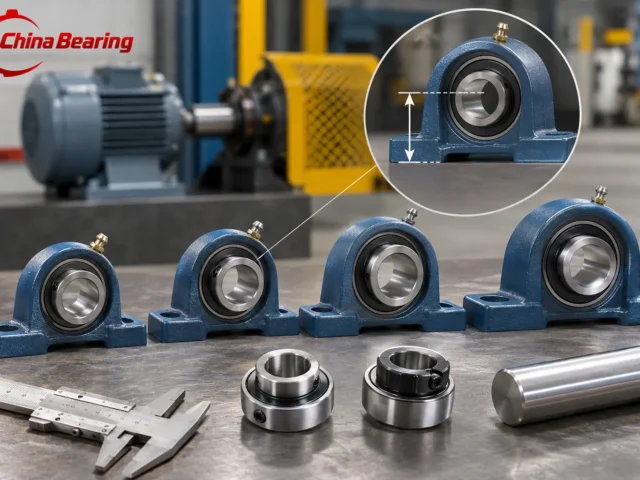
1 Inch Pillow Block Bearing: Which Unit Fits, and at What Shaft Height
A 1 inch pillow block bearing comes in several sizes that hold the shaft at different heights. Compare UCP205-16, UCPK205-16, UCSP205-16 and…
-
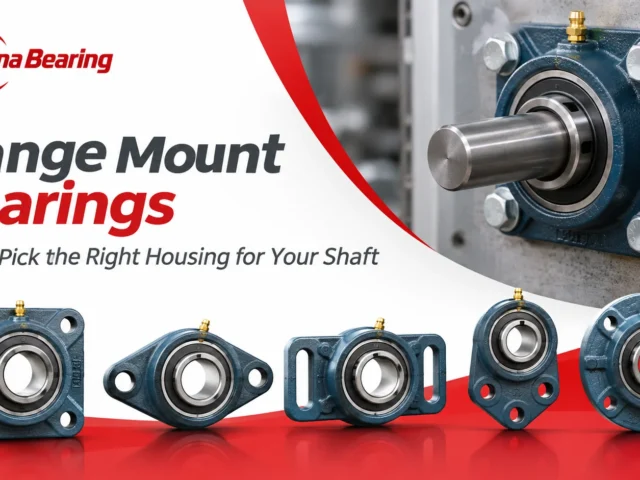
Flange Mount Bearings: How to Pick the Right Housing for Your Shaft
Flange mount bearings compared: 4-bolt UCF, 2-bolt UCFL, 3-bolt, adjustable and piloted UCFC housings, with real 205-size dimensions and mounting tips.
-
Pillow Block Bearings: How to Read the Part Number and Pick the Right One
Pillow block bearings explained: decode a UCP205 part number, pick set screw or eccentric collar locking, and avoid the inch-shaft trap.
Working with us
From a bearing number to the right part, with one engineering contact.
Send a part number, a drawing or the markings from the old bearing. We confirm the equivalent, the options and the lead time.
- Cross-reference helpOld markings or another brand's number, matched to an equivalent.
- Selection supportLoad, speed and fit checked against your duty before you order.
- Configurable optionsAsk about clearance, seals, cages and lubrication for your application.
- Clear quotesPrice, quantity breaks and lead time set out in one reply.