
Selection & sizing 7 min read
Flange Mount Bearings: How to Pick the Right Housing for Your Shaft
Flange mount bearings compared: 4-bolt UCF, 2-bolt UCFL, 3-bolt, adjustable and piloted UCFC housings, with real 205-size dimensions and mounting tips.
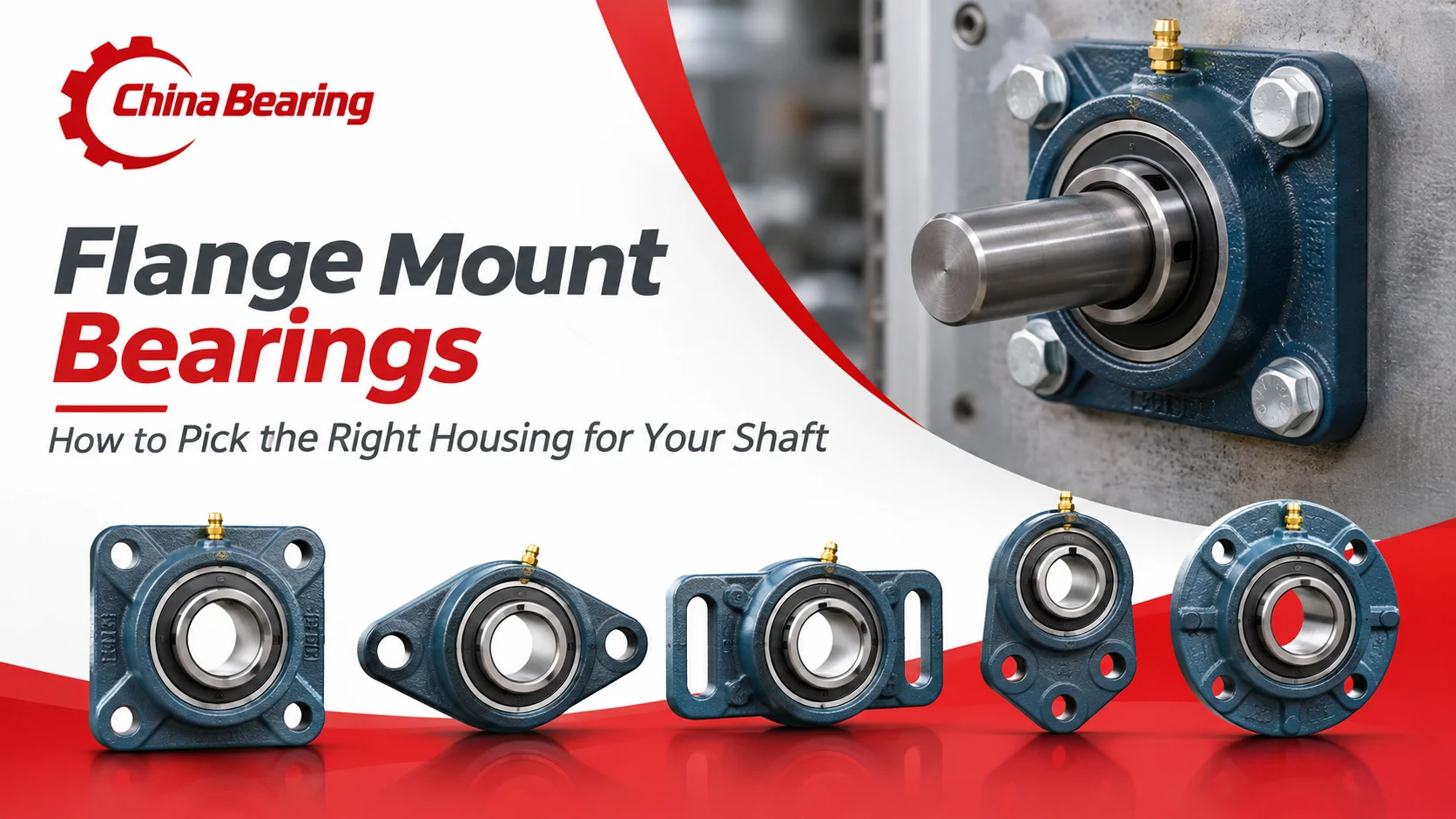
You have a shaft coming straight out of a wall, a frame plate or the side of a machine, and it needs support right where it passes through. That’s the job flange mount bearings do. GlobalSpec puts it simply: you use a flange unit when the shaft axis is perpendicular to the mounting surface. In addition, the bearing comes preassembled in the housing, so the whole unit bolts on as one part.
The part that trips buyers up is the choice of housing. For example, a 25 mm shaft can take a two-bolt, three-bolt, four-bolt, adjustable or piloted flange, and every one of them can hold the same insert bearing. So the decision is mostly about the space you have, the bolts you can fit and how accurately the shaft has to sit. This guide walks through each style with real catalog numbers. If your shaft runs parallel to the base instead, our pillow block bearings guide covers that housing.
Five flange mount bearings, one insert#
Here’s the detail that changes how you shop. Look up the 25 mm size in the common styles, and the insert inside is the UC205 every time.
| Unit | Style | Bolts | Footprint and bolt spacing | Source |
|---|---|---|---|---|
| UCF205 | Square, 4 bolt | 4 x M10 | 95 mm square, bolts 70 mm apart | Timken |
| UCFL205 | Diamond (rhombus), 2 bolt | 2 x M14 | 130 mm x 68 mm, bolts 99 mm apart | Timken |
| UCFA205 | Adjustable, 2 bolt | 2 x M10 | 125 mm x 68 mm, bolts 98 mm apart, 65 mm pilot | AMI via Applied |
| UCFB205 | Bracket, 3 bolt | 3 | Check the maker’s drawing | USA Roller Chain |
| UCFC205 | Piloted round | Check the maker’s drawing | Spigot locates in a bore | NSK, Timken |
Because the insert is the same, so is the load rating. Timken lists the UCF205 at 14,000 N dynamic and 7,850 N static, and the UCFL205 shares the same UC205 insert. Meanwhile, NTN rates its UCF205 at 5,900 RPM maximum. To turn those ratings into running hours, see our walkthrough of L10 bearing life in plain arithmetic.
In other words, switching from four bolts to two doesn’t cost you bearing capacity. Instead, what changes is how that load gets into your frame, how much room the housing takes and how easy it is to line up.
Four bolts, two bolts or three: fitting flange mount bearings to the space#
Since the insert stays the same, the housing shape is where flange mount bearings really differ. You can compare the shapes side by side in our flanged ball bearing units range.
Four-bolt square (UCF)#
The square unit is the default for a flat plate with room around the shaft. The load spreads over four smaller bolts, and the 95 mm square fits a fairly tight bolt pattern. So if you’re not sure which style to pick and the space is there, this is the one we’d start with.
Two-bolt diamond (UCFL)#
Timken says its UCFL series is designed mainly for applications where the mounting area is restricted. That’s the trade: the housing is long (130 mm on the 205 size) but only 68 mm wide. As a result, it fits on a narrow frame member where a 95 mm square won’t.
To make up for having only two fixing points, it uses bigger bolts. The UCFL205 takes M14 bolts through 16 mm holes, against M10 on the four-bolt square. Therefore, check that your frame can take holes that size before you commit. Two-bolt patterns also differ between standards. For instance, our F2B 25M-TF two-bolt flange unit for 25 mm shafts uses 98.8 mm bolt centres and M10 bolts.
RS lists agricultural, bakery, construction, forestry, marine and textile equipment as typical homes for two-bolt units. Plenty of those machines are built from narrow frame members, which is exactly where the two-bolt shape fits. Where dust, slurry or wash water are part of the job, a version with extra sealing such as the F2B 25M-TR with multiple-lip seals is worth a look. However, those extra seal lips lower its speed limit to 4,300 r/min.
Three-bolt bracket (UCFB)#
The three-bolt bracket sits between the two. USA Roller Chain describes the UCFB205 as a unit for limited space where the bearing mounts on one side, with three holes for stability. However, dimensions vary more between catalogs here, so get the drawing from whoever supplies it.
The adjustable flange solves a different problem#
A UCFA unit looks like a two-bolt flange, but the bolt holes are slots. An NTN listing describes its UCFA housing as made for applications where the shaft gets repositioned. Similarly, NSK’s drawing for the UCFA205D1 shows 49 mm long bolt slots.
That’s useful for chain or belt tension, where you need to slide the shaft a little after assembly. It also forgives bolt holes that were drilled slightly off.
One warning, though. Adjustable units don’t match as closely between brands as the standard square and diamond styles do. For example, AMI lists 98 mm between the bolts on its UCFA205, while NSK lists 96 mm for its UCFA205D1. With slots that hardly matters, but measure before you swap brands on an existing frame.
When the shaft has to sit exactly in the right place#
Every flange mount bearing housing carries manufacturing tolerances, and on standard units they’re bigger than many buyers expect. FYH’s catalog, for example, allows ±0.5 mm on the distance from the mounting face to the bearing center for its FL204 to FL210 two-bolt housings. On top of that, it allows a 0.7 mm tolerance on bolt hole position.
For a conveyor roller, that’s nothing. The inserts help too. They’re wide inner ring ball bearings, a type of rolling-element bearing, and Timken notes their spherical outside diameters compensate for shaft misalignment.
But if the shaft needs to line up with a gearbox, a motor coupling or a matched shaft on the far side of the machine, half a millimeter starts to show. That’s where the piloted round flange earns its price. The UCFC has a spigot (pilot) that fits into a machined bore in your mounting plate. According to Timken, this gives accurate mounting fits and better support for heavy loads. In short, the bolts hold the unit on, while the spigot does the locating.
The catch is that you need that machined bore. On a drilled steel plate with no bore, a piloted unit is just an expensive round flange. If you’re machining the bore anyway, our notes on shaft and housing fits such as K5 and H7 explain how tolerance classes are chosen.
Mounting tips for flange mount bearings#
Most flange mount bearings arrive ready to fit. Timken’s UCFL units, for example, come prelubricated, with a grease fitting for relubrication. Even so, a few habits help them last:
- Mount on a flat, clean face. A burr or weld spatter under one corner of a four-bolt flange tilts the whole housing.
- Fit both units on a shaft loosely first, rotate the shaft, then tighten the bolts. This lets the self-aligning inserts settle.
- Tighten the set screws last, after the housings are bolted down.
- Grease to the maker’s schedule, using the fitting on the housing.
- On a shaft end that stops at the housing, fit one of our bearing end covers to keep dirt out and hands away from the turning shaft.
For the full step-by-step routine, read our guide to mounting a bearing without damage. Also, Timken states its bolt spacing and shaft center location are interchangeable with competing units. That’s the main reason a standard UCF or UCFL is so easy to replace on old equipment.
Quick answers#
What is the difference between UCF and UCFL?#
UCF is a four-bolt square housing, whereas UCFL is a two-bolt diamond housing made for narrow mounting areas. On the 205 size both carry the same UC205 insert and load rating.
Can flange mount bearings take axial load?#
Some, through the insert, but catalogs rate these units mainly for radial load. So if you have a large steady thrust, ask the supplier to confirm a unit for it.
Are flange mount bearings interchangeable between brands?#
Standard UCF and UCFL sizes usually are, which is why Timken advertises it. Adjustable and three-bolt styles, on the other hand, vary more, so check the drawing.
Before you order any flange mount bearings, write down three numbers from the old unit or your frame: shaft diameter, bolt spacing and the distance from the mounting face to the shaft center. With those three, you can match almost any standard unit on the first try. You can browse our full mounted bearings range, or send the three numbers through our contact page and we’ll check the match for you.
Keep reading
The next questions engineers usually ask
-
1 Inch Pillow Block Bearing: Which Unit Fits, and at What Shaft Height
A 1 inch pillow block bearing comes in several sizes that hold the shaft at different heights. Compare UCP205-16, UCPK205-16, UCSP205-16 and…
-
Pillow Block Bearings: How to Read the Part Number and Pick the Right One
Pillow block bearings explained: decode a UCP205 part number, pick set screw or eccentric collar locking, and avoid the inch-shaft trap.
-
Roller Bearing vs Ball Bearing: How to Choose, With a Same-Size Example
A 6208 ball bearing and an NU 208 roller bearing share one 40 x 80 x 18 mm envelope, yet the roller…
Working with us
From a bearing number to the right part, with one engineering contact.
Send a part number, a drawing or the markings from the old bearing. We confirm the equivalent, the options and the lead time.
- Cross-reference helpOld markings or another brand's number, matched to an equivalent.
- Selection supportLoad, speed and fit checked against your duty before you order.
- Configurable optionsAsk about clearance, seals, cages and lubrication for your application.
- Clear quotesPrice, quantity breaks and lead time set out in one reply.
1 question